The Structural Warning Sign Triage adds up weights for the warning signs you tick, from 1 for sticking doors to 4 for a horizontal foundation crack, bowing wall or split beam. Quick change adds 3, and a recently removed wall adds 3 and forces at least Engineer soon. Heavy snow with a sagging roof is always Urgent. Scores map to Monitor, Get assessed, Engineer soon or Urgent.
- Twelve signs, each weighted 1 to 4 by how directly it points to structural failure.
- Changed quickly adds 3; stable and slowly worsening add nothing to the score.
- A renovation that removed a wall adds 3 and never returns less than Engineer soon.
- Heavy snow load plus a sagging roofline or ridge is Urgent regardless of the score.
- Bands: 0–2 Monitor, 3–5 Get assessed, 6–8 Engineer soon, 9 or more Urgent.
Structural Warning Sign Triage
01 /What does the Structural Warning Sign Triage do?
The triage turns a mix of warning signs into a single, consistent answer to the question most owners actually have: how worried should I be, and who should I call? You tick the signs you can see, say whether they are stable, slowly worsening or changed quickly, and pick any recent event. The tool adds up weights, applies three override rules, and returns a band, the reasons behind it, who to call and what to photograph.
It is a structured first read, not an inspection. It cannot see your house, measure a crack or tell shrinkage from settlement; it scores what you report. It is most useful for deciding between waiting and watching, booking an assessment, getting an engineer soon, and treating something as an emergency. For what each sign means, read signs of structural damage.
02 /What do you enter?
Three groups of inputs:
- Signs (tick all that apply): the twelve warning signs in the table below.
- Progression (pick one): stable, slowly worsening, or changed quickly.
- Recent events (pick one): none, renovation removed a wall, water event, or heavy snow load.
| Sign | Weight | Why this weight |
|---|---|---|
| Doors/windows sticking | 1 | Common from humidity alone; a weak signal on its own |
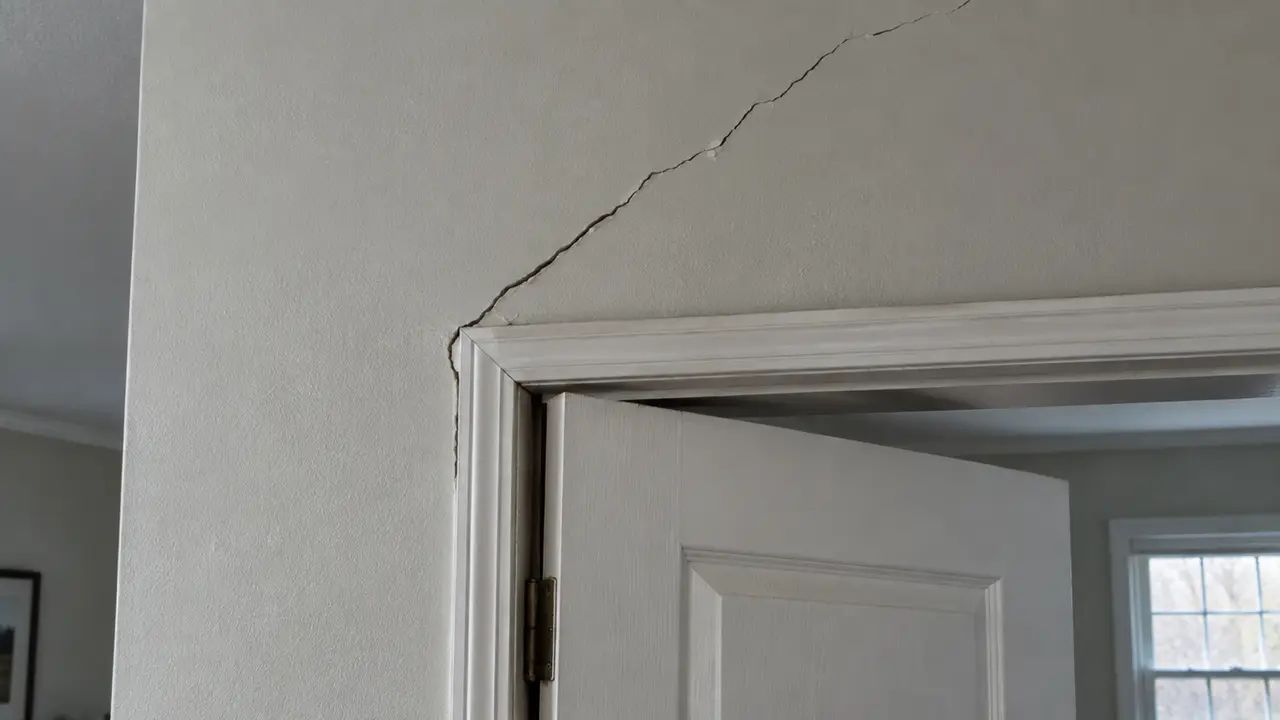
| Drywall cracks from corners of doors/windows | 1 | Openings concentrate normal movement |
| Sloping or bouncy floor | 2 | Points to sag or settlement, often long-standing |
| Gaps between trim and ceilings or floors | 1 | Shrinkage, truss uplift or movement |
| Stair-step or diagonal cracks in masonry | 2 | Differential settlement or heave |
| Horizontal crack in foundation wall | 4 | The wall is bending under lateral pressure |
| Bowing basement wall | 4 | The wall has already moved |
| Sagging roofline or ridge | 3 | Rafter spread, overload or altered framing |
| Cracked or split beam/joist | 4 | A structural member has failed or is failing |
| Leaning chimney | 3 | Chimney footing settling or masonry deteriorating |
| Floors separating from walls | 3 | A support below has dropped |
| Sinking post or column | 3 | Lost bearing under a concentrated load |
The weights follow a simple idea: signs that show a member has failed or a wall has been pushed out of line score 4; signs that point to an identifiable structural cause score 2 or 3; signs that are common in sound houses score 1. Several low-weight signs together still add up. Masonry cracks and a leaning chimney are explained in brick wall and chimney problems.
03 /How is the score calculated?
- Add the weights
The score starts as the sum of the weights of every sign you ticked. With every sign ticked, the sum is 31.
- Add 3 for quick change
If progression is "changed quickly", 3 points are added. "Stable" and "slowly worsening" add nothing to the number, although slow worsening is still a reason to measure and re-check.
- Add 3 for a removed wall
If the recent event is "renovation removed a wall", 3 points are added, and the result is raised to at least Engineer soon even if the total is lower. Why removed walls, cut joists and new openings cause trouble is covered in renovation damage.
- Apply the snow rule
If the recent event is "heavy snow load" and you ticked "sagging roofline or ridge", the result is Urgent, whatever the score.
- Band the result
Otherwise the band comes from the score.
A "water event" does not change the score on its own. It matters because water leads to rot, softened soils and washed-out bearing, and the signs that follow are what the tool weighs. A heavy snow load without a sagging roofline also adds nothing; the rule is triggered by the combination.
| Score | Band | Meaning |
|---|---|---|
| 0–2 | Monitor | Common, low-weight signs. Record, measure and re-check seasonally. |
| 3–5 | Get assessed | A structural cause is plausible. Arrange an assessment. |
| 6–8 | Engineer soon | Signs point to structural movement or damage. Book a structural engineer. |
| 9 or more | Urgent | Keep people clear, call an engineer, and arrange emergency shoring if needed. |
04 /What does the result show?
- The band, Monitor, Get assessed, Engineer soon or Urgent, with the score.
- The reasons: the signs and adjustments that produced it, including any override (a removed wall or heavy snow with a sagging roof).
- Who to call: a structural engineer, or a general or foundation contractor, depending on the result.
- What to photograph: the shots that make an engineer's or contractor's first look useful.
05 /Worked examples
| Signs and inputs | Calculation | Band |
|---|---|---|
| Sticking doors + drywall corner cracks, stable, no event | 1 + 1 = 2 | Monitor |
| Sloping floor + trim gaps, slowly worsening, no event | 2 + 1 = 3 | Get assessed |
| Sloping floor + trim gaps + sinking post, stable | 2 + 1 + 3 = 6 | Engineer soon |
| Horizontal crack + bowing wall, stable | 4 + 4 = 8 | Engineer soon |
| Horizontal crack + bowing wall, changed quickly | 4 + 4 + 3 = 11 | Urgent |
| Drywall corner cracks only, renovation removed a wall | 1 + 3 = 4, raised to the minimum | Engineer soon |
| Sagging roofline only, heavy snow load | 3, snow rule applies | Urgent |
| Sagging roofline only, no event | 3 | Get assessed |
The last two rows show why the snow rule exists: the same sagging roofline is a planning item in July and an emergency under a February snow load.
06 /How should you use the result, and what are its limits?
Use the band to decide the next step and how soon, not to diagnose. Before you call anyone, gather what the result asks you to photograph and any measurements: crack widths with a dated pencil mark, floor sag from the Floor Sag Calculator, wall bow with a plumb line. Those records make an engineer's first visit faster and more useful.
- It scores what you tick. Misreading a sign, such as a pour line taken for a horizontal crack, or truss uplift taken for roof sag, changes the result. The guides on horizontal cracks and roof and truss problems help you tell them apart.
- It does not measure severity within a sign. A hairline and a 10 mm crack score the same weight; your measurements and the progression input carry that information.
- It is not a code check or an engineering assessment. It uses editorial weights to rank common signs; it does not know your house's loads, spans or soils.
- Low scores are not clearances. A single sign that worries you is reason enough to get it looked at.
For costs of the repairs these signs lead to, see the structural repair cost guide. To get a person's read on your result, send a request with your photos. StructuralRepair.ca is part of HAUSE Home, an independent information and service-request network; it is not a contractor or engineering firm.
FAQQuestions people ask
Is the triage an engineering assessment?
No. It is a structured way to rank the signs you report and decide how soon to get help. Only an on-site assessment by a qualified professional can diagnose the cause.
Why does a removed wall force Engineer soon?
Because a wall removed without an adequate beam, posts and footings can overload the framing above and below, and problems can develop over weeks. The load path needs checking even if few signs have appeared yet.
Why does slowly worsening not add points?
The tool adds points only for quick change, the clearest sign of active movement. Slow worsening still matters: measure and date it, and if it keeps progressing, get an assessment.
Why is heavy snow with a sagging roof always Urgent?
Because a roof that is already sagging under a large snow load may be near its capacity, and snow load can increase quickly with more snow, drifting or rain. People should be kept out of the rooms below.
My result is Monitor. Should I do anything?
Yes: mark and date cracks, photograph them with a scale, measure floor sag, and re-check each season. If anything changes, run the triage again.