These are the questions Canadian homeowners and buyers most often ask about structural problems: which cracks matter, whether a sagging floor is dangerous, how to tell a load-bearing wall, what settlement means, when to hire a structural engineer, whether repairs need permits, what insurance covers and what repairs cost. Each answer links to a deeper guide.
- Direction, displacement and change over time decide whether a crack matters.
- Most structural repairs that change the load path need a building permit; confirm locally.
- Engineers must be licensed by a provincial or territorial regulator; check the public directory.
- Gradual structural problems are generally not covered by home insurance.
01 /About these answers
The answers below are general information for houses in Canada, written to be accurate on their own and short enough to read in a minute. They are not an assessment of your house. Codes, permit rules and insurance policies vary by province, municipality and insurer, so confirm anything that affects a decision with your municipality, your insurer and a licensed engineer.
Dollar figures are planning estimates. For the full ranges and what drives them, see the structural repair cost guide. For a quick read on your own signs, use the Structural Warning Sign Triage or the Floor Sag Calculator.
FAQAll questions
What are structural repairs?
Structural repairs restore or improve a building's ability to carry its loads safely: sistering or replacing joists and rafters, adding beams, posts and footings, bracing or rebuilding foundation walls, underpinning settling footings, repairing fire, water or rot damage and restoring spalled concrete or rusted steel. Cosmetic repairs to finishes are not structural.
What are the signs of structural damage in a house?
The serious ones are horizontal cracks or bowing in basement walls, cracked or split beams and joists, sinking posts, a sagging roofline and floors separating from walls. Sticking doors and drywall corner cracks are common alone but matter in clusters. See signs of structural damage, and for brick and chimneys, brick wall and chimney problems.
Are horizontal cracks in a foundation normal?
No. Vertical hairline shrinkage cracks are common, but a horizontal crack in a basement wall usually shows bending under soil or frost pressure. A straight pour line from construction can look similar. See horizontal foundation cracks.
Are sagging floors dangerous?
Usually not immediately, but they can be. Split or cracked framing, crushed bearings, rot, sag that is increasing or cracking sounds need urgent attention. An old, stable dip over sound framing is usually a repair-when-convenient item. See sagging floors.
How much floor sag is acceptable?
Commonly cited limits are L/360 under tile or plaster and L/240 otherwise: about 11 mm and 17 mm on a 4 m span. These are design criteria for new work, so an older floor beyond them is a flag to investigate. Try the Floor Sag Calculator.
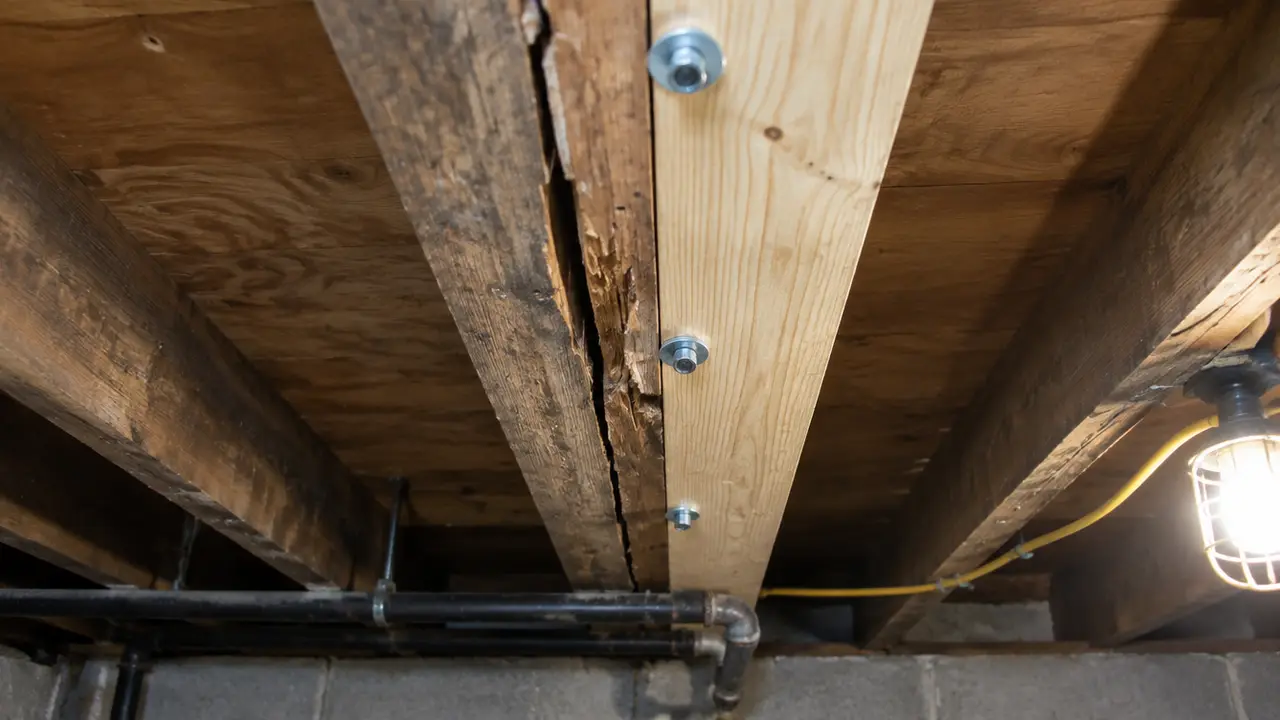
What does sistering joists mean?
Fastening a new joist alongside a weak, cracked, cut or sagging one so the pair carries the load together. It works best full length, bearing on both supports, after the old joist is jacked up. See sistering floor joists.
How do I know if a wall is load-bearing?
Look for joists or rafters landing on it, a beam, wall or posts directly beneath it in the basement, and walls stacked above it. Exterior walls are almost always bearing. Only seeing the framing above and below confirms it. See load-bearing walls.
Can a load-bearing wall be removed?
Yes, by replacing it with a beam supported by posts that carry the load down through every floor to proper footings, usually designed by an engineer and built under a permit. See removing a load-bearing wall and LVL vs steel beams.
What is foundation settlement?
The downward movement of a foundation as soil beneath it compresses, dries, softens or washes away. Even settlement is usually harmless; differential settlement, where parts drop by different amounts, cracks and distorts the house. See foundation settlement.
Can joists cut by a plumber or electrician be repaired?
Yes. Over-notched or over-drilled joists are usually sistered with a full-length member, or the service is rerouted between joists and the damage reinforced to an engineer's detail. See cut joists and renovation damage.
Is a sagging or pulling-away deck a structural problem?
Yes. Deck failures usually start at the ledger connection to the house, at shallow footings that heave or sink, or at rotted posts and joist ends. Keep people off until it is checked. See deck structural problems.
What does a structural engineer do?
Assesses structural problems on site, determines the cause and whether it is active, writes letters and reports, and designs repairs with authenticated drawings a contractor can build and a municipality can permit. See what a structural engineer does.
Do structural engineers need to be registered?
Yes. In Canada, practising engineering or using the title engineer requires a licence from the provincial or territorial regulator where the work is done. There are 12 regulators, including APEGA in Alberta.
How much does a structural engineer charge for a house?
A residential site visit and letter typically falls in the $500–$1,500 planning range for 2026; beam or wall-removal designs with stamped drawings about $1,000–$3,500; foundation repair designs more. Get a written fee proposal.
What is a structural engineer's report?
A signed document recording what the engineer saw and measured, their opinion on the cause, whether it is active and what should be done, with stated limits. A shorter version is a site visit letter. See reports and drawings.
Which structural repairs need a building permit?
Usually, when the work changes how the house carries loads: removed or moved walls, new beams, posts and footings, underpinning and new openings. Like-for-like maintenance may not. Confirm with your municipality. See structural repair permits.
Is foundation repair covered by homeowners insurance?
Usually not. The Insurance Bureau of Canada notes that most policies exclude damage like cracking, shifting or settling of a foundation, and insurance is designed for sudden and accidental events. Check your own policy, and see does insurance cover structural repairs.
Does a new-home warranty cover structural defects?
Often, for a set period. Structural coverage runs 10 years in Alberta and British Columbia, 7 years under Ontario's Tarion warranty and 5 years in Quebec, and it stays with the house when it is sold. See does insurance cover structural repairs for claims, tax and financing.
How much does structural repair cost?
Planning ranges for 2026 run roughly $1,000–$5,000 for minor repairs, $5,000–$20,000 for moderate work such as a new beam line or wall bracing, and $20,000–$60,000 or more for underpinning, rebuilds or major damage, plus engineering.
Can structural repairs go ahead in a Canadian winter?
Much interior work, such as bracing, posts, beams and some pier installations, can be done year-round. Excavation, concrete and exterior work in frozen ground are harder and may cost more or wait for spring, unless the problem is urgent.
Does a sagging roof need to be fixed right away?
An old, stable sag can be planned. New sag, growing sag or any sag under a heavy snow load is urgent: keep people out of the rooms below and get help. See roof sag, trusses and snow load.
What should I do if I hear cracking sounds from the ceiling?
Get everyone out of that area and the rooms below, do not add load, and call a structural engineer or emergency contractor. Call 911 if collapse seems imminent. See emergency shoring.
Should I buy a house with structural issues?
It can make sense if you learn the cause, whether it is active and the repair cost before your conditions expire. Bring in a structural engineer after the home inspection flags a concern. See buying a house with structural issues.
Can water damage weaken a house's structure?
Yes. Wet wood is temporarily weaker, prolonged moisture causes rot and mould, and flowing water can wash soil from under slabs and footings. Drying quickly limits the damage. See fire, water and rot damage.
Does StructuralRepair.ca do repairs or engineering?
No. StructuralRepair.ca is part of HAUSE Home, an independent information and service-request network. It does not perform work or engineering. You can send a request and the desk will reply with next steps and, where available, a local professional.