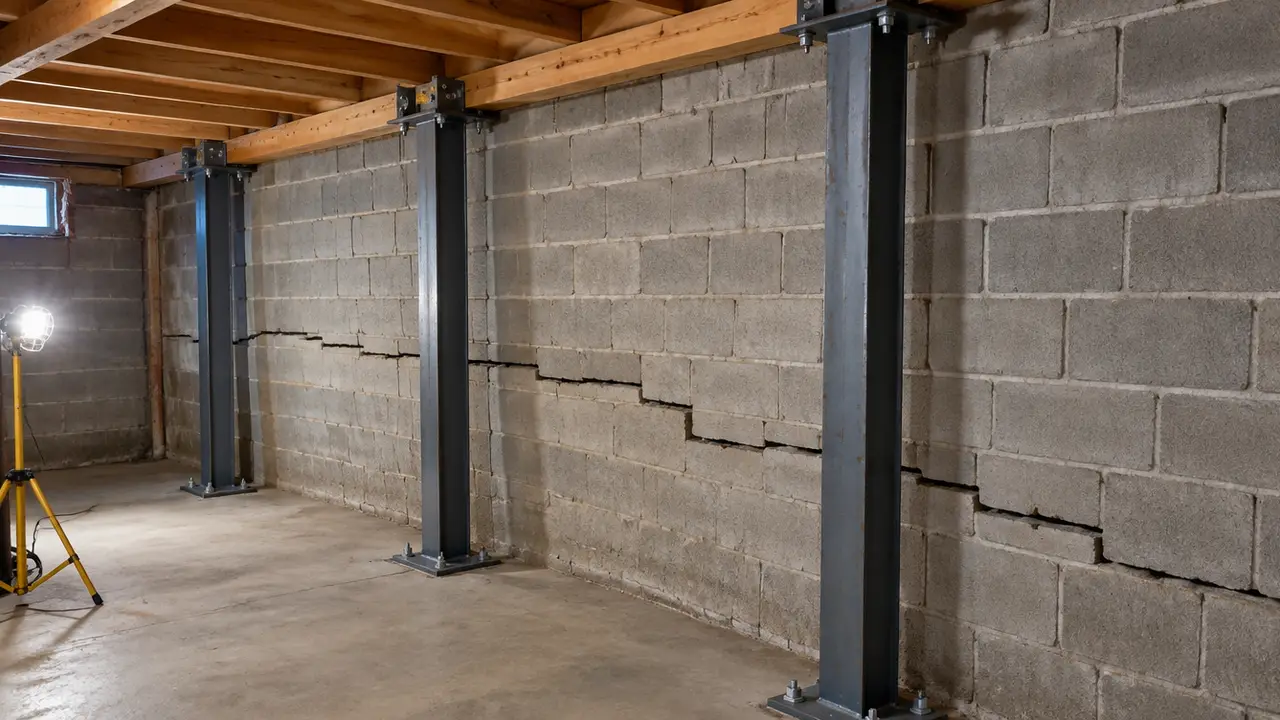
A horizontal crack in a basement wall usually means the wall is bending inward under pressure from outside: saturated or frozen soil, expansive clay or heavy loads nearby. It is more serious than a vertical shrinkage crack because a structural load is at work. The fix is to reduce the pressure and brace or rebuild the wall to an engineer's design; sealing alone does not restore strength.
- Horizontal cracks show bending from lateral pressure; vertical hairline cracks usually show shrinkage.
- A thin, straight, dry horizontal line in poured concrete may be a pour line (cold joint), not a failure.
- Displacement, inward bowing, a step at the crack, or change over time make it urgent.
- Block walls crack along a mortar joint, often a few courses below grade, and bow as a panel.
- Repairs combine drainage and grading with bracing, anchors or reconstruction; injection only seals water.
01 /What does a horizontal crack in a foundation mean?
A horizontal crack in a foundation wall usually means the soil outside is pushing the wall inward harder than the wall can resist in bending. A basement wall works like a vertical beam: held at the bottom by the footing and slab, held at the top by the floor framing, and loaded along its height by soil pressure. When that pressure exceeds what the wall was built for, it cracks on the inside face along a horizontal line near where bending is greatest, typically somewhere between mid-height and a little below grade.
That is why horizontal cracks are treated differently from vertical ones. A vertical hairline crack in poured concrete is usually shrinkage and says little about load. A horizontal crack says the wall has been, and may still be, loaded past its capacity.
02 /What causes horizontal cracks in foundation walls?
Horizontal cracks come from lateral pressure, and several things raise it:
| Cause | Mechanism | Clues |
|---|---|---|
| Saturated soil | Wet soil is heavier and adds water pressure against the wall | Worse after rain or snowmelt; poor grading, short downspouts |
| Frost pressure | Water in soil next to the wall freezes and expands, pushing inward | Cracks near the frost zone, unheated spaces, garages, winter movement |
| Expansive clay | Clay swells when it takes on water | Clay-rich backfill, seasonal cycles |
| Surcharge loads | Driveways, parked vehicles, heavy equipment or soil piles close to the wall | Crack along the side next to a driveway or lane |
| Early backfilling | Soil placed before the floor framing braced the wall top | Cracks from construction, often visible early |
| Tall unbalanced fill | A wall holding back much more soil than it was designed for | Walk-out lots, regraded yards, raised gardens against the house |
In Canadian winters, frost deserves special attention. Where soil against the wall is wet and the basement or crawl space is cold, as in an unheated garage wall, a vacant house or a well-insulated basement interior that lets the wall get colder, frost can push hard on the upper part of the wall. Keeping water away from the wall is the common thread in every cause.
03 /Is it a structural crack or a pour line?
Not every horizontal line in poured concrete is a crack from pressure. When concrete is placed in stages and one layer starts to set before the next arrives, a cold joint or pour line forms: a thin, usually straight line, sometimes with a slight colour or texture change, that runs along the wall at a consistent height. Cold joints can leak, but they do not by themselves show that the wall is bending.
Block walls have no cold joints; a horizontal crack in a block wall runs along a mortar joint and is almost always from lateral pressure. It is often accompanied by stair-step cracks near the corners, where the bowing panel meets the stiff corners of the wall.
04 /How serious is a horizontal foundation crack?
It depends on displacement and change. A dry, hairline, straight horizontal line with no bowing that has not changed in years is at the low end. A crack with the wall bowing in, a step where one part sits proud of the other, or movement since last season is at the high end.
- Engineer now: any horizontal crack with inward bowing, displacement, a wall that has slid at the base or pulled away from the floor framing at the top, or measurable change over weeks or months.
- Get it assessed soon: a new horizontal crack, a horizontal crack in block walls at any width, or a horizontal crack plus water.
- Monitor with data: a hairline line that looks like a pour line, with a plumb wall, confirmed stable by dated measurements.
Horizontal cracks above grade on the outside of the house are often something else: cracks in the parging (the cement coating on exposed concrete), the joint where the foundation meets the framing, or damage from frost or impact near grade. They still deserve a look, but they are not the same as a bending crack inside the basement.
05 /How do you measure and document a horizontal crack?
- Photograph it
Wide shots showing the whole wall, then close-ups with a ruler or coin for scale, at the same angle each time.
- Measure width and offset
Use a crack width card or feeler gauge at marked points. Check whether one side sits proud of the other with a straightedge.
- Check the wall for bow
Hang a plumb line or hold a long level vertically at the crack and measure the gap from the line to the wall at the top, the crack and the bottom.
- Mark and date
Pencil tick marks at the ends and at measurement points, with the date. Crack monitors that straddle the crack show movement to a fraction of a millimetre.
- Repeat seasonally
Readings after spring melt, in summer, in fall and in deep winter reveal whether movement follows water and frost.
Bring those records to the engineer. They turn a judgement call into an evidence-based decision on whether bracing is needed and how urgent it is. For how bowing is measured and braced, see bowing basement walls.
06 /How are horizontal foundation cracks repaired?
A horizontal crack is repaired by reducing the pressure behind the wall and giving the wall the strength it lacks. Filling or injecting the crack seals it against water but does not stop a wall that is bending.
- Relieve the pressure. Slope grade away from the wall, extend downspouts, move vehicles and heavy loads away, and check that foundation drainage works. For drainage and waterproofing in Calgary, see CalgaryFoundations.com.
- Brace the wall. Steel beams from the slab or footing to the floor framing, or carbon-fibre straps bonded to the wall for smaller movement, stop further inward movement.
- Anchor it. Wall anchors or helical tiebacks through the wall into stable soil outside resist the pressure, and can sometimes be tightened gradually.
- Excavate and straighten or rebuild. For severe bowing or displaced block walls, the soil is removed outside, the wall is straightened, reinforced or rebuilt, and new drainage and backfill are placed.
- Then seal. Once the wall is stabilised, the crack is sealed or injected to keep water out. How epoxy and polyurethane injection differ is explained in concrete and steel structural repair.
| Repair | Typical planning range |
|---|---|
| Engineer's assessment and letter | $500–$1,500 |
| Crack injection (sealing only) | $500–$1,200 per crack |
| Steel or carbon-fibre wall brace | $600–$1,500 per brace |
| Wall anchors or helical tiebacks | $800–$2,000 per anchor |
| Excavate, straighten or rebuild a wall | $15,000–$40,000+ per wall |
For the full cost picture, see the structural repair cost guide. If you have a horizontal crack now, the Structural Warning Sign Triage weights it heavily for a reason; send a request with photos and measurements for next steps.
FAQQuestions people ask
Are horizontal cracks in a foundation bad?
They are more concerning than vertical hairline cracks because they usually show the wall bending under soil or frost pressure. Displacement, bowing or growth make them urgent; a stable pour line may not be structural.
Is a vertical or horizontal crack in a foundation worse?
Generally horizontal. Vertical hairline cracks are typically shrinkage; horizontal cracks show lateral load. Wide, tapered or displaced vertical cracks can also be structural, so width and change matter too.
What does a hairline horizontal crack in a foundation mean?
In poured concrete, it may be a cold joint from construction, especially if it is straight, level and unchanged. In block walls, or with any bowing, treat it as a pressure crack and have it assessed.
Can horizontal foundation cracks be fixed?
Yes. The pressure behind the wall is reduced and the wall is braced, anchored, or excavated and rebuilt to an engineer's design, then the crack is sealed.
How much does it cost to fix a horizontal crack in a foundation?
Sealing alone is roughly $500–$1,200 per crack, but that is not a structural fix. Bracing typically runs $600–$1,500 per brace, and full excavation and rebuilding can exceed $15,000 per wall (2026 planning ranges).
Can I fix a horizontal foundation crack myself?
You can control grading and downspouts yourself, which helps. Bracing, anchors and rebuilding are structural work that should follow an engineer's design, usually with a permit.