The signs of structural damage that matter most are horizontal cracks or bowing in basement walls, cracked or split beams and joists, sinking posts, a sagging roofline, floors pulling away from walls and any change that happens quickly. Sticking doors, drywall cracks at door corners and small trim gaps are common in sound houses, but several of them together, or growing, are worth an assessment.
- One sign rarely tells the story; a cluster of related signs in one part of the house does.
- Direction and change matter more than size: horizontal, displaced or growing cracks outrank wide but stable vertical ones.
- Seasonal sticking doors and hairline drywall cracks are common in Canadian houses and usually cosmetic.
- Split framing, sinking posts, bowing walls and a sagging ridge go to a structural engineer, not a handyman.
- Measure and date what you see; a record over two seasons is the most useful thing you can hand an engineer.
01 /What counts as structural damage?
Structural damage is anything that reduces a building's ability to carry its loads safely to the ground: the weight of the house itself, people and furniture, snow on the roof, wind, and soil pushing on the basement walls. Every house has a load path. Roof loads travel down through rafters or trusses to the walls, floor loads travel through joists to beams and bearing walls, beams sit on posts, and everything ends at footings resting on soil. Damage anywhere along that chain, or movement of the soil under it, shows up as symptoms somewhere else, often a floor or two away from the cause.
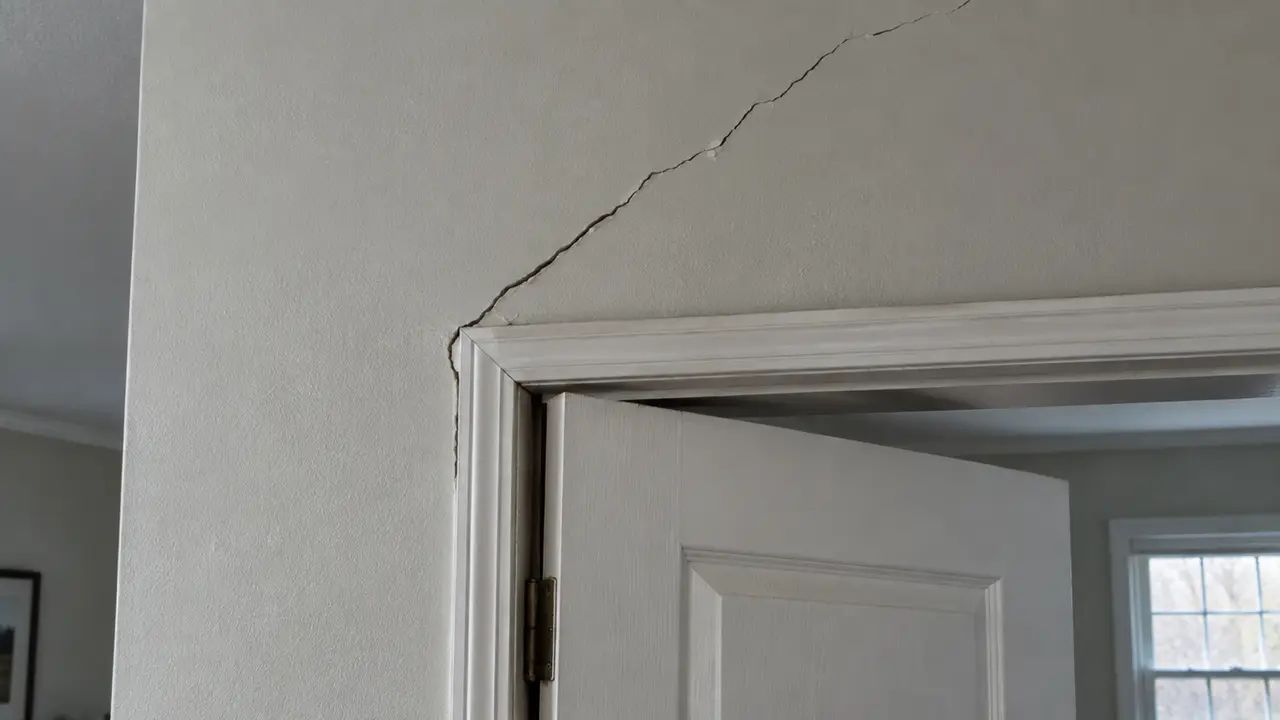
That is why a crack above a bedroom door can start in the basement. A centre post that sinks 10 mm lets the beam above it drop, the floor joists follow, the wall on top of them lowers, and the drywall above the door frame, the weakest point in that wall, cracks at the corner. Reading warning signs well means tracing them back along the load path rather than treating each one as a separate problem.
Not every crack or sloping floor is damage. Wood shrinks as it dries in its first heating seasons, concrete shrinks as it cures, and Canadian houses swing between humid summers and very dry heated winters, so small cracks and seasonal sticking are normal. The job is to separate the everyday movement of a sound house from movement that is structural and continuing.
02 /Which warning signs are most serious?
The most serious signs are the ones that show a structural member has failed or a wall is being pushed out of line. The table ranks common signs by what they usually indicate; the weights are the same ones the Structural Warning Sign Triage uses.
| Sign | What it usually points to | Level of concern |
|---|---|---|
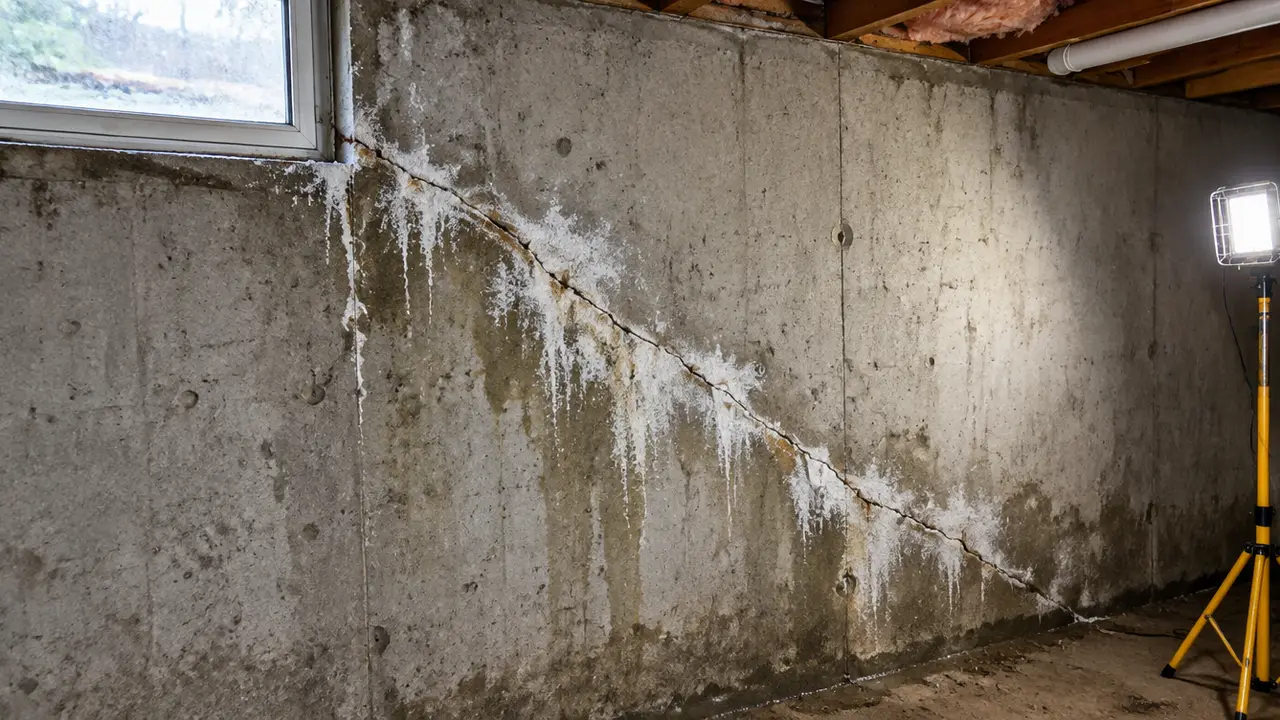
| Horizontal crack in a basement wall | Soil or frost pressure bending the wall inward | High: engineer |
| Bowing or leaning basement wall | Wall already displaced by lateral pressure | High: engineer |
| Cracked or split beam or joist | A member overloaded, notched, rotted or damaged | High: engineer |
| Sagging roofline or ridge | Rafters spreading, undersized framing, altered trusses or overload | High: engineer, urgent under heavy snow |
| Sinking post or column | Undersized or missing footing, soft soil, rot at the post base | Medium to high |
| Floors separating from walls | A beam, bearing wall or foundation dropping | Medium to high |
| Leaning chimney | Chimney footing settling or masonry deteriorating | Medium to high |
| Sloping or bouncy floor | Sagging joists or beam, settled posts, removed support | Medium |
| Stair-step or diagonal cracks in masonry | Differential settlement or heave | Medium |
| Doors or windows sticking | Frame racking from movement, or just humidity | Low on its own |
| Drywall cracks from door and window corners | Movement concentrates at openings | Low on its own |
| Gaps between trim and ceilings or floors | Framing movement, shrinkage or truss uplift | Low on its own |
Three things move any sign up the list: speed, displacement and company. A crack that has opened visibly in a few weeks is more urgent than a wider one that has not changed in years. A crack where one side sits proud of the other, or a wall that has slid at its base, shows actual movement rather than shrinkage. And a sign surrounded by related signs, such as a sloping floor above a sinking post beside a door that recently started to stick, tells a consistent story that needs an assessment.
03 /What do different cracks mean?
A crack's direction tells you which way the force acted. Vertical hairline cracks in poured concrete are usually shrinkage. Diagonal cracks running from the corners of windows and doors show one part of the wall moving down or up relative to another. Stair-step cracks along mortar joints in block or brick show the same differential movement in masonry. Horizontal cracks in basement walls are different in kind: they show the wall bending under pressure from the soil outside.
- Width. Hairline (under about 1 mm) cracks are common. Cracks you can slide a coin into deserve a closer look, especially in block or brick.
- Taper. A crack wider at one end than the other shows rotation: one part of the wall is dropping or lifting relative to the rest. Wider at the top often points to settlement at a corner; wider at the bottom can point to heave.
- Offset. If one face of the crack is displaced in or out from the other, the wall has moved, not just cracked.
- Location. Cracks at corners of openings are expected stress points. Long horizontal cracks mid-height in a basement wall, or cracks that run through a beam, are not.
- Drywall versus structure. Drywall and plaster crack easily and show movement well, but a drywall crack only tells you something moved; the structure behind it tells you why.
Horizontal cracks and bowing walls have their own guides: horizontal foundation cracks and bowing basement walls. For settlement cracks, read foundation settlement; for bulging brick, lintel cracks and leaning chimneys, see brick wall and chimney problems; and for damage that appears after a renovation, see cut joists and renovation damage. Foundation waterproofing and leak repair are covered by our sister site CalgaryFoundations.com.
04 /Which signs are usually cosmetic?
Several very common signs are usually not structural, especially in a house where they appear on their own and do not change from year to year.
- Seasonal sticking doors
Wood doors and frames swell in humid summers and shrink in dry winters. A door that sticks in August and swings freely in January is humidity. A door that suddenly starts to bind in every season, with a crack above it, is movement.
- Nail pops and tape cracks
Framing lumber shrinks as it dries, pushing drywall screws and nails out and opening joints between sheets. They are common in the first few years of a house or addition.
- Ceiling-to-wall gaps in winter
In many truss-roofed houses the ceiling lifts off interior partitions in winter and settles back in summer. This is truss uplift, a moisture-driven bending of the truss bottom chord, and it is not a structural failure. The roof and truss guide explains how to tell it from sag.
- Vertical hairline cracks in poured walls
Concrete shrinks as it cures and cracks, often near windows or mid-wall. Dry, stable and hairline, these are normally a monitoring item. If one leaks, it is a waterproofing job rather than a structural one.
- A slight slope in an old floor
Many houses built before modern span tables have floors that sagged decades ago and stopped. The question is not whether the floor is perfectly level but whether it is still moving. See sagging floors.
05 /How do you check your house for structural problems?
A useful self-check follows the load path from the bottom up, because most structural problems start low. Take a flashlight, a phone camera, a tape measure, a pencil and a long level or a string line.
- Basement walls. Look for horizontal cracks, bowing, inward lean at the top or bottom, and stair-step cracks in block. Sight along the wall from a corner; a bow is often easier to see than to measure.
- Beams, posts and joists. Look for splits, crushed wood where a beam sits on a post or pocket, rot at post bases, posts that are out of plumb, and joists cut or notched deeply for pipes and ducts.
- Main floor. Walk it in socks; notice dips and bounce. Lay a long level or pull a string between walls to measure sag, as described on the Floor Sag Calculator.
- Walls and openings. Note cracks at door and window corners, doors that have started to bind, and trim separating from floors or ceilings.
- Outside. Look for stair-step cracks in brick, a chimney leaning away from the wall, a ridge line that dips, bulging wall sections and gaps where steps or porches meet the house.
- Roof space. From the hatch, look for cracked rafters, cut truss webs, and plates or gussets that have pulled loose. Step only on framing.
06 /When should you call a structural engineer?
Call a structural engineer when a sign points to failure or active movement: horizontal cracks, bowing walls, split beams or joists, a sagging ridge, a post that is sinking, floors separating from walls, or any sign that is changing quickly. Also call one before you remove a wall, after a fire, flood or vehicle impact, and when buying a house with an unexplained slope or crack. An engineer assesses the cause, not just the symptom, and can design a repair a contractor builds and a municipality can permit. Read what a structural engineer does for how that works.
Some problems belong with a contractor first. A leaking crack with no displacement is a waterproofing job. A single rotted deck post is a carpentry job, provided the rot has not spread into the house framing. Squeaky floors are a flooring question, covered by our sister site CalgaryFloors.ca. The Structural Warning Sign Triage sorts a mix of signs into four bands, from monitor to urgent, and suggests who to call.
StructuralRepair.ca is part of HAUSE Home, an independent information and service-request network. HAUSE Home is not a contractor or an engineering firm and does not perform work. If you send a request with photos and a description, the HAUSE Home desk replies with next steps and, where one is available and you agree, puts you in touch with a local engineer or contractor.
FAQQuestions people ask
What are the first signs of structural damage?
Often doors that start to bind, new cracks at the corners of doors and windows, and floors that feel different underfoot. On their own these are common; together, in one area, or getting worse, they are worth tracing back to the foundation, posts and beams.
Are cracks in drywall a sign of structural problems?
Usually not on their own. Drywall cracks easily with normal shrinkage and seasonal movement. Cracks that keep growing, reappear after repair, or come with sloping floors or sticking doors in the same area point to movement worth investigating.
Is a horizontal crack worse than a vertical crack?
In a basement wall, generally yes. Vertical hairline cracks are typically shrinkage. A horizontal crack shows the wall bending under soil or frost pressure and should be looked at by a structural engineer.
Can structural damage be repaired?
Most residential structural damage can be repaired: joists sistered, beams and posts added, walls braced, footings underpinned and roofs reinforced. The right repair depends on the cause, which is why an assessment comes first.
How fast does structural damage get worse?
It varies from decades to days. Shrinkage and old sags are often stable. Settlement tied to wet or drying soils can move seasonally. Failures after fire, water damage, heavy snow or wall removal can progress quickly and should be treated as urgent.
Who should I call first, an engineer or a contractor?
If the sign involves a horizontal crack, bowing wall, split beam, sagging roof or rapid change, start with a structural engineer so the repair is designed for the cause. For simple, clearly non-structural items, a qualified contractor is fine.